
Water Systems Dispatch#1: How are the institutions responding to sewage contamination in drinking water?
Hawapani Foundation | April 2026
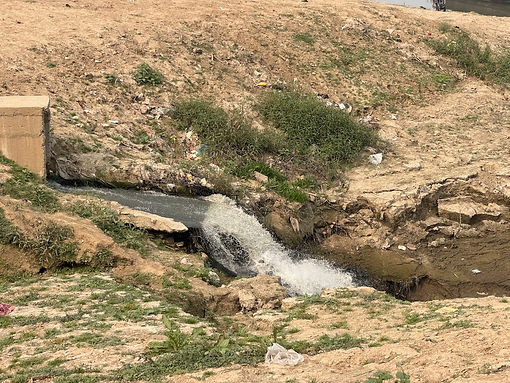
Water quality issues are increasingly drawing national attention, with recent cases reported on severe health consequences for local populations across multiple Indian cities including Indore, Noida, and Gandhinagar. According to a Down to Earth report, between January 2025 and January 7, 2026, at least 5,500 people fell ill across 26 cities, including 16 state capitals, in 22 states and Union Territories after consuming sewage-contaminated piped drinking water with at least 34 deaths reported.
While causes, immediate responses, expert commentary, and historical warnings have been widely reported and discussed, far less structured information exists on how these incidents are being taken up within the National Green Tribunal (NGT). This update examines how these issues are addressed in the tribunal, who is involved, how institutions respond over time, and what shapes the deliberations. It also brings out the environmental knowledge embedded within these processes.
What’s happening in the NGT?
The NGT’s Principal Bench is currently deliberating on three suo motu cases, all initiated based on news reports:
“Indore jaisi trasadee kee rah par Rajasthan shudh payjal ko taras rahe hamare shahar” (Rajasthan Patrika, 04.01.2026)
“99% Water Supply Safe On BMC’s Paper But Ground Reality Tells A Lethal Tale” (Free Press Journal, 05.01.2026)
“Sewage Gaps: Disasters Lie in Wait & Water” (Times of India, 02.01.2026)
All three matters were registered on 09.01.2026 and are now listed together. The next hearing is scheduled for 26.05.2026.
Who are the respondents?
Across the three connected matters, NGT has impleaded the following as respondents:
Rajasthan Pollution Control Board
Madhya Pradesh Pollution Control Board
Uttar Pradesh Pollution Control Board
Integrated Regional Office, Jaipur, Ministry of Environment, Forest and Climate Change (MoEF&CC)
Integrated Regional Office, Bhopal, MoEF&CC
Integrated Regional Office, Lucknow, MoEF&CC
Central Pollution Control Board (including Member Secretary)
District Magistrate (Collector), Bhopal
The presence of multiple state pollution control boards, regional MoEF&CC offices, and district administration reflects the cross-jurisdictional and systemic nature of the issue.
What do we know from the submissions so far?
Only the Uttar Pradesh Pollution Control Board (UPPCB) and the Central Pollution Control Board (CPCB) have submitted responses so far. Their affidavits are dated 28.02.2026 (UPPCB) and 06.03.2026 and 07.03.2026 (CPCB).
Key findings from the UPPCB submission:
In a letter dated 06.02.2026, almost a month after the Noida incident and more than 20 days after the NGT order, the Regional Office of UPPCB wrote to the Additional Chief Executive Officer, Greater Noida Industrial Development Authority regarding complaints of foul smell, discoloured water supply and consequent health impacts in Sector Delta-I, Greater Noida
The affidavit states that no information was provided by the Greater Noida Industrial Development Authority until 26.02.2026, prompting a reminder from UPPCB on the same date.
Water samples for drinking supply were collected on 23.02.2026 from locations including C-62, C-192, A-168, and E-207 in Delta-I—more than a month after the incident.The analysed samples did not detect E. coli contamination.
Key findings from the CPCB submission:
CPCB states that the responsibility for design, laying, and maintenance of water supply systems lies with local bodies.
It refers to the Manual on Water Supply and Treatment Systems – “Drink from Tap” published in March 2024 by the Ministry of Housing and Urban Affairs (the manual hereafter). The manual can be accessed here : Manual on Water Supply and Treatment Systems - Drink From Tap - March 2024 : Ministry of Urban Development
The manual outlines safeguards such as mapping vulnerable points (e.g., where water and sewer lines intersect) on GIS systems and to update them in Asset Management Plans.
It mandates regular monitoring of water quality at production, distribution, and consumer points to ensure compliance with IS 10500 standards.
It also requires random sampling in cases of suspected contamination and documentation of control measures.
The manual further details roles and responsibilities across agencies:
Agency | Function | Responsibilities |
Surveillance Agency 1. State PHED 2. Urban Local Body 3. Local Health Authority, CMO/Public Officer 4. State Pollution Control Board | Surveillance of drinking water quality |
|
Water Supply Agency 1.State PHED/Water Boards/Urban Development Department 2. Urban Local Bodies/Authorities 3.Autonomous Agencies | Supply of potable water |
|
Central Pollution Control Board and State Pollution Control Board/Authority | Controlling pollution of the water source |
|
On transparency, an MoEF&CC notification dated 04.10.2021 mandates that water quality data be regularly communicated to consumers through billing and public media. Parameters to be disclosed include turbidity, TDS, pH, E. coli, and residual chlorine, among others.
Even as this dispatch was being drafted, another similar incident was reported from Dhaulpur, Rajasthan on 14.04.2026 (News18 Hindi).
Why this matters
It is important to understand what mandates already exist, where they are located, and who the responsible authorities are when such incidents occur. As seen from the CPCB’s submission and the 2024 manual by MOHUA, roles are clearly defined across agencies, from local bodies, water utilities, pollution control boards, and health authorities.
However, even where detailed recommendations exist, on monitoring frequency, infrastructure safeguards, and public disclosure, their implementation remains to be assessed. In the absence of strong regulatory follow-up, transparency of data, and timeliness of action, accountability of institutions are compromised.
The submissions so far point out how water quality governance requires multiple systems to work together, i.e., urban local bodies, pollution regulators, public health agencies, and administrative authorities. The manual mentioned above also outlines the role of civil society forums and active citizenry. Without efficient coordination across these institutions, responsibilities become fragmented and outcomes uncertain.
Tracking these proceedings is therefore not just about legal developments. It helps illuminate how systems function, how responsibilities are fulfilled, and how transparency and access to reliable water quality information can be enhanced for citizens.
*This analysis is based on publicly available documents, filings before the Tribunal, and information available on official websites. The matter is currently under consideration in the National Green Tribunal, Principal Bench.
This is Water Systems Dispatch #1 in a series tracking environmental governance systems of water ecosystems.
Comments